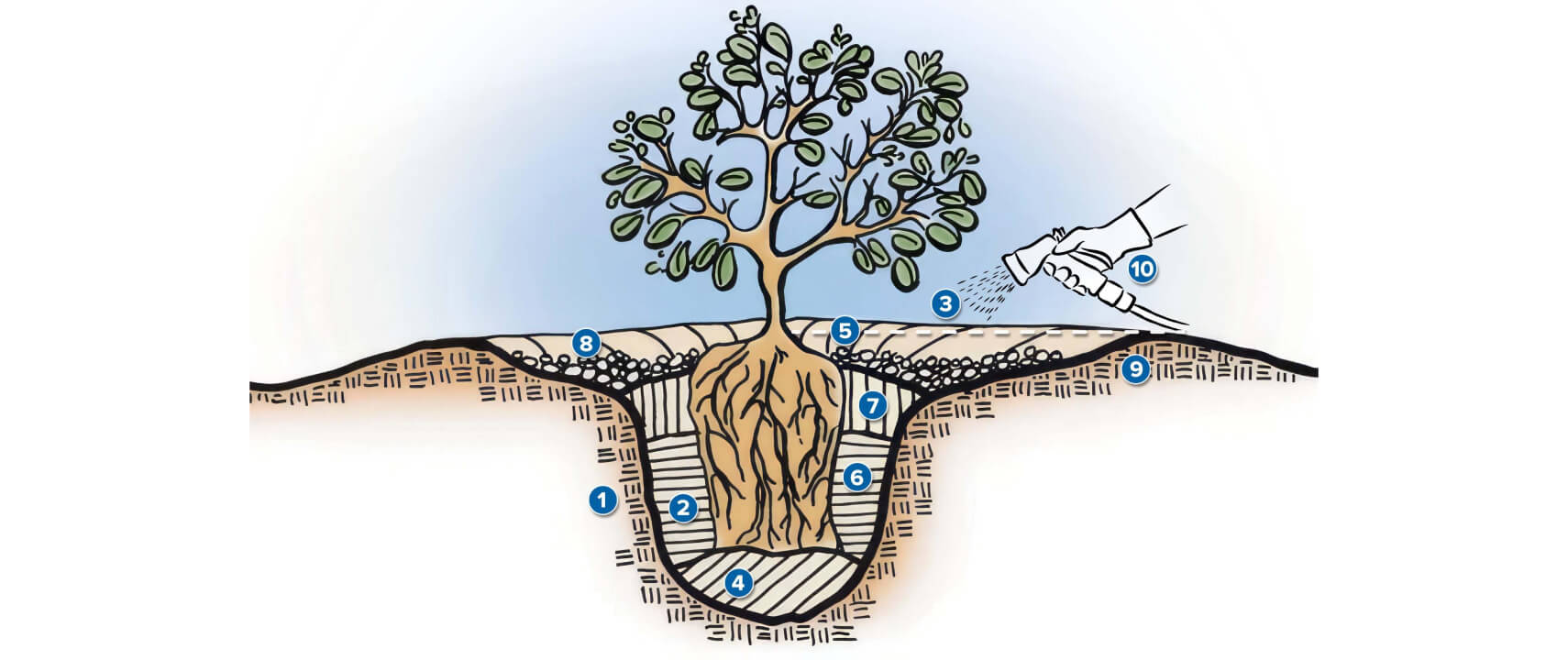
Fall through early spring is the best time to plant California’s native low-water-use plants. Like all nursery stock, these plants need careful attention during their establishment period. Use this planting diagram to follow these ten easy steps.
Additional smart watering tips: It’s important that the root ball does not dry out during the first two or three months. Irrigate about once a week, trying not to oversoak the surrounding soil. After two months, be sure to water deeply, but do not allow the ground to remain soggy for long periods of time, as this encourages disease, especially during the dry season
Twice as deep and twice as wide as the plant container. Break up large clods and try to avoid the smooth-sided “bathtub” effect in the hole.
a) For many landscape and revegetation plantings, no soil amendment is recommended for California-friendly plants. The native soil should be left soft and easy to crumble. Eliminate rocks and large clods from your backfill soil.
b) For landscapes requiring amendment, use approximately 1/3 composted or nitrolized forest humus to 2/3 native soil, blending them in a pile outside the hole.
c) Slow-release fertilizer granules or tabs may be incorporated with the backfill, or placed in the bottom of the hole. If tabs are used, make sure they are not touching the root ball. Most California-friendly plants are able to find nutrients even in poor soils. If a pre-plant fertilizer is used, application rates should be lower than those used for non-native ornamentals.
Allow water to percolate (drain) into the subsoil.
Spill the material into the bottom of the hole, moisten, tamp, and mound slightly.
It should be atop the moistened backfill so that the plant collar is one inch higher than the finished grade.
Do this while adding water flowing slowly from a hose into the hole, backfilling up to about 2/3 the height of the root ball: moistening, tamping, and settling all around.
Surround the top of the root ball with more backfill. Be sure the collar is still higher than grade.
It should be considerably outside the dimension of the hole using the remaining backfill and native soil.
Apply a generous portion (approximately 2 to 4 inches deep) of a coarse, organic, weed-free, and disease-free mulch; topdressing around the exposed collar and inside the entire basin area.
Fill the basin with water and sprinkle around to settle backfill, mulch, and berm. Allow to soak in and repeat.